Dangerous Tree Assessment and Removal: Signs You Should Never Ignore
A dangerous tree rarely fails without warning. The problem is that most warnings are subtle at first, easy to dismiss, and often hidden in plain sight. Homeowners notice a little lean, a patch of dead limbs, mushrooms near the trunk, or a crack that appeared after a storm. Then life gets busy. A month passes, then a season. By the time the tree finally comes down, it is no longer a tree care issue. It is a roof claim, a crushed fence, a blocked driveway, a damaged vehicle, or an injury.
That pattern is familiar to anyone who has worked in tree care for long enough. Trees can stand for decades looking strong from the street while carrying severe internal decay, root loss, or structural defects. On the other hand, some trees look rough but remain stable for years with the right pruning, support, and monitoring. That difference matters. Good decisions come from careful assessment, not guesswork.
Dangerous Tree Assessment and Removal is not just about taking down anything that looks imperfect. It is about understanding risk, identifying failure points, and deciding whether a tree can be retained safely through management or whether removal is the only responsible option. Sometimes the answer involves Tree Pruning & Crown Shaping to reduce end weight and remove deadwood. In other cases, Tree Cable and Bracing can provide support for a codominant stem or a weak union. And sometimes the defects are severe enough that Tree Removal Services become necessary without delay.
Why dangerous trees are often misjudged
People usually judge a tree by its canopy. If it has green leaves in spring and summer, they assume it is healthy. That is a natural mistake. A tree can leaf out and still be structurally unsound. Stored energy can push seasonal growth even when the trunk is decaying or the roots are failing. I have seen large shade trees fully leafed out with hollow trunks, active fungal decay, and root plates already lifting from the soil. To an untrained eye, they looked fine until you stood underneath and saw daylight through cavities or felt the ground heave underfoot.
The opposite mistake also happens. A tree with sparse foliage or some deadwood is not automatically dangerous. Drought stress, pest pressure, compacted soil, and past construction damage can weaken a tree, but risk depends on where the defects are, how extensive they are, what species is involved, and what targets sit nearby. A dead tree in an open field is a very different issue from a compromised oak leaning over a child’s bedroom.
That is why a Certified Arborist Consultation has real value. Assessment is part biology, part structure, part site analysis. Species characteristics matter. So does age, soil condition, past pruning, exposure to wind, and whether the tree stands alone or sheltered in a group. A pine at the edge of a property may react very differently to storm loading than a mature live oak in a protected backyard. There is no shortcut that replaces trained inspection.
The signs that deserve immediate attention
Some warning signs justify prompt evaluation, especially when the tree is close to people, homes, garages, driveways, sidewalks, utility lines, or neighboring property. These are the issues I would never advise a homeowner to ignore:
- A new or worsening lean, especially if the soil is lifting or cracking around the base
- Large dead limbs, broken tops, or a canopy with significant dieback
- Vertical cracks, cavities, or seams in the trunk or major scaffold limbs
- Mushrooms or conks growing from the trunk, root flare, or buttress roots
- Recent storm damage, including split unions, hanging limbs, or lightning injury
A lean deserves special attention because timing matters. Many trees naturally grow with some lean and remain stable for years. What raises concern is change. If a tree that stood upright last year is now tilting toward a house, or if the root plate is beginning to lift on one side, that can indicate root failure in progress. In soft or saturated soils, Certified Arborist Consultation failure can happen quickly.
Dead limbs are another major issue, particularly over occupied areas. A limb does not need to be enormous to cause harm. Even a branch six to eight inches in diameter can do serious damage when dropped from height. Larger leaders or scaffold branches can punch through roofing, crush fencing, and injure anyone below. In many cases, targeted Tree Pruning & Crown Shaping can remove those hazards and restore safer structure. In other cases, widespread dieback points to decline throughout the tree.
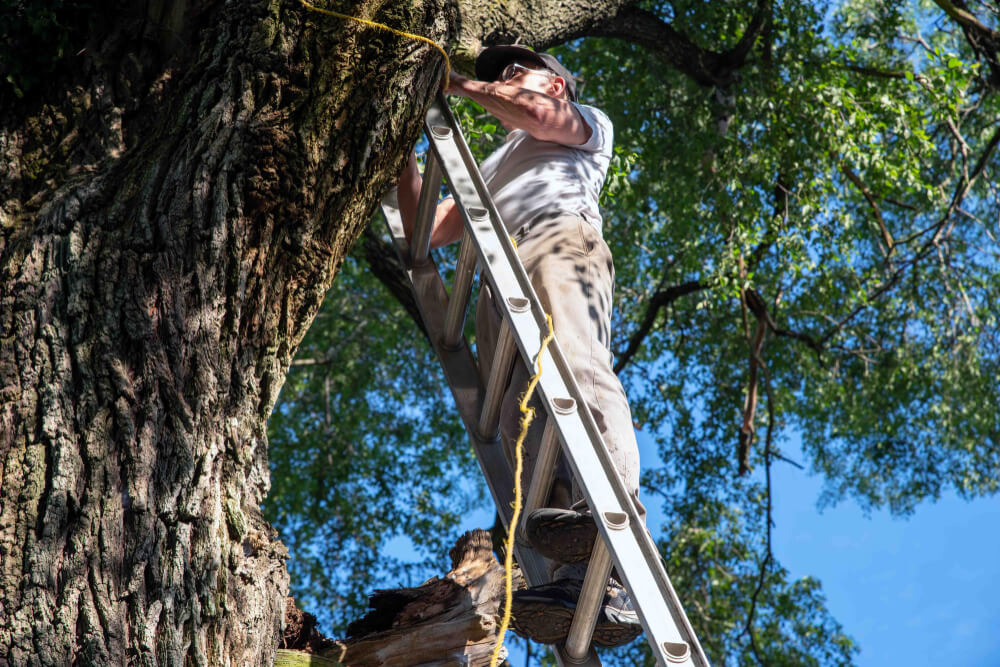
Cracks and seams require careful judgment. A shallow bark crack may be relatively minor. A deep vertical split through the trunk, especially one associated with included bark or codominant stems, is another matter entirely. Those failures often happen with little warning under wind load. If the crack opens and closes during gusts, the situation is already advanced.
Fungal growth near the base tells a story many property owners miss. Mushrooms in the lawn are not necessarily a concern, but conks attached to the trunk or root flare often indicate internal decay. The exact risk depends on the fungus, the host species, and the location of the decay, but visible fruiting bodies mean the organism has been active long enough to produce reproductive structures. By the time that happens, the tree may have lost a substantial amount of sound wood.
Storm damage creates a separate category of risk because it can convert a stable tree into an unstable one in a single afternoon. A tree that lost a major limb may now be imbalanced. A split union may hold through one storm and fail in the next. Lightning can strip bark, kill cambium tissue, and leave a tree structurally compromised even if the canopy still appears green.
What happens below ground matters just as much
Root problems are among the most dangerous and least understood tree issues because the damage is often out of sight. When homeowners call after a tree falls, the post-failure evidence commonly points to root loss, root decay, girdling roots, or soil disturbance.
Construction is a Tree service frequent trigger. Trenching for irrigation, foundations, pools, patios, driveways, and utilities can sever a major percentage of a tree’s support roots. The damage does not always show immediately. Sometimes the tree declines over two to five years, and sometimes it remains green until a wet winter or wind event pushes it past its limit.
Grade changes also matter. Adding soil over roots can suffocate them. Removing soil can expose and destabilize them. Repeated traffic from vehicles or heavy equipment compacts the soil and reduces oxygen exchange. Overwatering around the base can encourage decay in species that prefer well-drained conditions.
One of the more deceptive scenarios involves a healthy-looking tree on a recently developed lot. The house is new, the landscaping is fresh, and the retained mature trees give the property character. But during construction, the roots may have been cut on multiple sides, the grade may have changed, and the remaining root system may no longer support the canopy. A tree like that can stand for a short time and then fail once the first major storm arrives.
This is one reason Dangerous Tree Assessment and Removal should include the site history whenever possible. If the tree stood through thirty years of ordinary weather and only began showing stress after excavation or pavement work, that context is not incidental. It is central to the diagnosis.
Species, structure, and the problem of false confidence
Some tree species compartmentalize decay better than others. Some are more prone to brittle wood, included bark, weak branch attachments, or root disease. Experience teaches caution here. It is easy to become overconfident with large familiar trees because they have always been there. Mature trees create a sense of permanence. In reality, size increases consequence. A small failing ornamental may damage a shrub bed. A failing seventy-foot tree can damage a house and cross property lines in seconds.
Structure often tells you more than canopy color. Codominant stems, especially those with included bark, are a classic example. From the ground they may look balanced and attractive, but the union can be weak because bark is trapped between the stems instead of solid wood interlocking. Over time, as the stems expand, they press against each other until one tears away. Tree Cable and Bracing may help in selected cases, especially when installed before cracking occurs, but support systems are not a cure for every structural defect. They reduce risk, they do not erase it.
Past pruning also leaves clues. Topping, lion-tailing, or improper heading cuts can create long-term hazards. Topped trees often respond with dense sprouts attached weakly to the remaining stubs. Those sprouts grow fast, become heavy, and break out later. Lion-tailed branches carry foliage at the ends with little interior support, increasing leverage and breakage risk. Poor pruning from years earlier is one of the most common contributors to dangerous branch structure.
When pruning can solve the problem, and when it cannot
Not every hazardous condition requires full removal. That is worth stating plainly because some trees can be preserved safely with the right work. Selective Tree Pruning & Crown Shaping can lower risk by removing deadwood, shortening overextended limbs, reducing weight over targets, improving branch spacing, and restoring a better balance after storm damage. In certain mature trees, moderate reduction is a practical way to reduce failure potential without sacrificing the entire canopy.
Support systems also have a place. Tree Cable and Bracing can help stabilize weak unions or heavy lateral limbs when the tree has good overall health and the defect is limited. The best results come when those systems are part of a broader management plan, not a substitute for one. They need appropriate installation, periodic inspection, and realistic expectations.
There are limits, though. If the trunk is significantly hollow at the base, if root decay is advanced, if major cracks are active, or if a large percentage of the canopy is dead, intervention may no longer be enough. In those situations, Tree Removal Services are often the safer and more economical decision. I say economical because homeowners sometimes spend money trying to postpone an inevitable removal while the risk continues to grow. Repeated small interventions on a terminally compromised tree can cost more than timely action.
A good arborist should be candid about that trade-off. Preservation is valuable, but preserving a tree that has become structurally unreliable over a home is not sound stewardship. It is avoidance.
Emergency situations change the timeline
Some assessments can wait a few days for a scheduled inspection. Others cannot. After severe wind, ice, saturated soil, or lightning, the threshold for calling Emergency Tree Services should be low. A partially uprooted tree, a split trunk, a large hanging limb, or a stem resting on another tree can shift unexpectedly. Those are not do-it-yourself conditions. People get hurt approaching storm-damaged trees because the stored tension in wood is unpredictable and often invisible.
A common example is the branch that appears stuck harmlessly in the canopy. From the ground it looks motionless. In reality, it may be one bounce away from dropping. Another is the tree that has not fully fallen but is suspended against a neighboring trunk or roofline. Those jobs require rigging, access planning, and controlled dismantling. The wrong cut can release the load in the wrong direction.
Emergency Tree Services are not only about speed. They are about stabilizing a dangerous situation with proper equipment and decision-making under pressure. That often means securing the area first, evaluating targets, and deciding whether the tree should be removed whole, dismantled in sections, or made temporarily safe until full removal can occur.
Wildfire risk adds another layer
In fire-prone areas, hazardous tree work overlaps with defensible space planning. Wildfire Mitigation Tree Services are often discussed in terms of clearance and fuel reduction, but tree condition matters too. Dead or dying trees can become ladder fuels, ember catch points, or falling hazards during fire response and evacuation. A weakened tree near a driveway can block access when it matters most. A declining conifer with heavy dead lower limbs increases the chance that surface fire climbs into the canopy.
Mitigation does not mean stripping a property bare. It means reducing combustible material while preserving healthy, appropriate trees where possible. Pruning lower limbs, removing deadwood, increasing spacing in dense stands, and taking out severely stressed or diseased trees can improve both fire resilience and day-to-day safety. In that context, Dangerous Tree Assessment and Removal becomes part of a broader property protection strategy, not a standalone service.
The stump question people delay too long
After removal, many property owners ask whether the stump really needs attention. Sometimes it can remain, depending on location. Often it should not. Stumps near walkways, lawns, driveways, or planting areas create practical and safety problems. They become trip hazards, attract pests in some settings, and interfere with replanting or new construction.
Stump Removal & Grinding is usually the cleanest way to finish the job. Grinding reduces the stump below grade so the area can be backfilled and reused. Full removal may be preferred when a future foundation, utility run, or hardscape feature is planned. The right choice depends on what comes next for the site. This is another place where the cheapest immediate option is not always the best long-term one. Leaving a large stump in a prominent area often becomes a recurring annoyance that homeowners end up addressing later at a higher total cost.
What a proper assessment should include
A solid tree risk evaluation is more than a glance from the sidewalk. It should account for the tree’s species, age class, site conditions, structural defects, signs of decay, root environment, and the likelihood of impact on a target. The arborist should also ask practical questions. How often is the area occupied? Is the tree over a bedroom, a play area, or a garage that is rarely used? Has the site been excavated recently? Did the lean appear after a storm? Are there irrigation changes, drainage issues, or signs of repeated branch failure?
The outcome should be specific. Sometimes that means monitor and reassess in six to twelve months. Sometimes it means prune within the season. Sometimes it means install Tree Cable and Bracing and inspect regularly. Sometimes it means remove the tree as soon as possible. Vague reassurance is not enough when visible defects exist.
Homeowners should expect plain language. If a tree is considered high risk, the reason should be understandable. If the risk is moderate and manageable, the management steps should be clear. Good tree care is not about selling the biggest job. It is about matching the recommendation to the condition.
If you suspect a tree is dangerous, take these steps
- Keep people, pets, and vehicles out of the drop zone
- Do not climb, cut, or park under the tree to investigate further
- Photograph visible defects and note any recent changes, such as a new lean or soil lifting
- Arrange a Certified Arborist Consultation promptly
- Use Emergency Tree Services immediately if the tree is cracked, uprooting, storm-damaged, or threatening a structure
Those steps sound basic, but they prevent many bad outcomes. The most expensive tree failures are often preceded by a period of uncertainty when everyone noticed something was wrong and nobody wanted to overreact. With trees, delayed action is sometimes the real risk.
The value of timing
There is a sharp difference between planned removal and crisis removal. Planned Tree Removal Services happen on a controlled schedule, with easier access, better crew positioning, and fewer surprises. Emergency work often involves wet ground, damaged structures, obstructed access, unstable wood, and greater time pressure. That usually means higher cost and more complexity.
The same principle applies to preservation work. Installing support hardware before a union splits is far more effective than trying to salvage it afterward. Pruning a heavy limb before storm season is better than cleaning it up after it tears out. Removing a declining tree before it dies completely is often safer because the wood is more predictable and the canopy can still be climbed or rigged with fewer complications.
Timing also affects replanting. If a hazardous tree is removed proactively, the homeowner can plan for a replacement tree suited to the space, soil, and climate. That is far easier than restoring a landscape after a catastrophic failure has torn up turf, irrigation, fences, and nearby plantings.
A final practical perspective
Most trees with minor defects do not need dramatic action, but significant warning signs deserve respect. Large dead limbs, active cracks, base decay, root disturbance, sudden lean, and storm damage are not cosmetic problems. They are structural clues. The right response might be pruning, support, monitoring, or removal, but doing nothing should be a conscious decision based on qualified assessment, not wishful thinking.
Well-managed trees add shade, value, habitat, and character to a property for decades. Neglected hazards do the opposite in a single event. If a tree on your property has been giving you that uneasy feeling every time the wind picks up, trust that instinct enough to have it evaluated. Dangerous Tree Assessment and Removal is ultimately about protecting people first, then making the best possible decision for the landscape that remains.
Name: Ace Tree Services Ltd.
Address: 4656 Wallace Hill Rd, Kelowna, BC V1W 4C2, Canada
Phone: 250-212-9593
Website: https://acetree.ca/
Email: [email protected]
Hours:
Sunday: Closed
Monday: 7:00 AM–5:00 PM
Tuesday: 7:00 AM–5:00 PM
Wednesday: 7:00 AM–5:00 PM
Thursday: 7:00 AM–5:00 PM
Friday: 7:00 AM–5:00 PM
Saturday: 7:00 AM–5:00 PM
Time zone: Pacific Time
Open-location code / Plus code: RHF8+8G Kelowna, British Columbia, Canada
Map/listing URL: https://www.google.com/maps/search/?api=1&query=Google&query_place_id=ChIJxRVIBx2LfVMRNRSkp6-IC0U
Embed iframe:
Socials:
https://www.facebook.com/p/Ace-Tree-Services-61585901931447/
Ace Tree Services Ltd. provides professional tree care from its Kelowna location on Wallace Hill Road.
The official website lists tree removal, stump removal and grinding, tree pruning and crown shaping, emergency tree services, certified arborist consultation, dangerous tree assessment and removal, tree cabling and bracing, and wildfire mitigation.
Ace Tree Services serves homeowners, businesses, and property owners in Kelowna and throughout the Okanagan Valley.
The company’s official site highlights ISA Certified Arborist support, local Okanagan experience, and fully insured tree service work.
Customers can contact Ace Tree Services for planned tree maintenance, high-risk removals, storm-related tree concerns, pruning, stump grinding, and arborist consultation needs.
The supplied public listing address is 4656 Wallace Hill Rd, Kelowna, BC V1W 4C2, near rural and residential service areas in southeast Kelowna.
For tree services in Kelowna and the Okanagan, call 250-212-9593, email [email protected], or visit https://acetree.ca/
The public map listing uses plus code RHF8+8G Kelowna, British Columbia, Canada and can help customers find Ace Tree Services Ltd. near Wallace Hill Road.
Popular Questions About Ace Tree Services Ltd.
What does Ace Tree Services Ltd. do?
Ace Tree Services Ltd. provides tree removal, stump removal and grinding, tree pruning and crown shaping, emergency tree service, certified arborist consultation, dangerous tree assessment and removal, tree cabling and bracing, and wildfire mitigation.
Where is Ace Tree Services Ltd. located?
Ace Tree Services Ltd. is listed at 4656 Wallace Hill Rd, Kelowna, BC V1W 4C2, Canada.
What phone number should customers call?
Customers can call Ace Tree Services Ltd. at 250-212-9593.
What is the email address for Ace Tree Services Ltd.?
The supplied email address is [email protected].
What are Ace Tree Services Ltd.’s hours?
The supplied listing hours show Monday through Saturday from 7:00 AM to 5:00 PM, with Sunday closed, Pacific Time. The official website lists 7:00 AM to 5:00 PM, Monday through Friday, so customers should confirm Saturday availability before booking.
Does Ace Tree Services Ltd. provide emergency tree service?
Yes. The official website lists emergency tree services, including emergency tree removal, dangerous tree assessment, emergency stabilization, and limb or branch cleanup.
Does Ace Tree Services Ltd. offer arborist consultations?
Yes. The official services page lists certified arborist consultation as one of the company’s Okanagan tree services.
Does Ace Tree Services Ltd. provide stump grinding?
Yes. The official services page lists stump removal and grinding as a service.
What areas does Ace Tree Services Ltd. serve?
The official website states that Ace Tree Services serves Kelowna and the Okanagan Valley.
How do I contact Ace Tree Services Ltd.?
Call 250-212-9593, email [email protected], visit https://acetree.ca/, or use the listed social profile: Facebook.
Landmarks Near Kelowna, BC
Wallace Hill Road: The road listed for Ace Tree Services Ltd. and a practical reference point for the company’s Kelowna location.
East Kelowna: A nearby rural and residential area where tree maintenance, pruning, removals, and wildfire mitigation can be important for property owners.
Myra-Bellevue Provincial Park: A major outdoor landmark southeast of Kelowna and a useful reference for the surrounding hillside and forested areas.
Gallagher’s Canyon: A nearby Kelowna community with residential properties, mature trees, and landscape maintenance needs.
Kettle Valley: A southeast Kelowna neighborhood with homes, parks, and landscaped properties.
Mission Creek Greenway: A well-known natural corridor in Kelowna and a local reference point for tree-lined recreation areas.
Orchard Park Shopping Centre: A major Kelowna retail landmark and citywide reference point.
Downtown Kelowna: A central business and residential district within Ace Tree Services’ broader Kelowna service area.
Okanagan Lake: A major regional landmark running through Kelowna and the surrounding Okanagan Valley.
Mission Creek Regional Park: A recognizable Kelowna park and natural landmark with extensive trees and trails.
Rutland: A large Kelowna community with residential and commercial properties that may need tree service support.
Glenmore: A Kelowna neighborhood with homes, parks, and established trees.
Lower Mission: A residential and lake-adjacent Kelowna area where pruning, tree health, and property safety can matter for homeowners.
Kelowna International Airport: A major transportation landmark north of central Kelowna.
West Kelowna: A nearby Okanagan community across the lake and a practical regional service reference.
For tree removal, stump grinding, pruning, crown shaping, emergency tree service, arborist consultation, dangerous tree assessment, cabling and bracing, or wildfire mitigation near these Kelowna and Okanagan landmarks, contact Ace Tree Services Ltd. at 250-212-9593, email [email protected], or visit https://acetree.ca/